
A new paper by David Soldani envisions an industry future defined by an operator-controlled 6G. Rakuten Mobile is the reference case for how the wider industry can achieve this goal.
The process begins with changes to five business practices that currently constrain mobile operators’ strategic prospects. Next, industry transition involves three phases. Its success depends on seven industry stakeholder groups playing their part.
This post explains Soldani’s views about the challenges and requirements to achieve an operator-controlled 6G before examining other stakeholder initiatives and competing visions that are influencing industry action.
Five Problematic Practices
According to Soldani, mobile networks operators (MNOs) need to upend five problematic practices. The first stems from a loss of control cause by their reliance on vendor-led architectures. While operators procure and operate networks, telemetry data is inaccessible or aggregated beyond utility. As a result, operators cannot modify, easily automate, or validate vendors’ performance claims. Operators are therefore renting intelligence while operating under an illusion of control.
Secondly, network operators prioritize peak data rates whereas they should focus on delivering verifiable outcomes. MNOs need to replace the language of radio physics with the language of customer outcomes. In Soldani’s framing, network outcomes apply to service level agreements. This is not the same as business outcomes such as manufacturing throughput or customers served.
Thirdly, operators are set up for megabyte consumption pricing. New practices, however, need to target pricing guarantees. Soldani provides an example of a guarantee-based price bundle. This consists of a premium subscription, a price related to SLA outcomes with penalty clauses, and consumption-based pricing for inferencing, API-calling, and network-as-a-service configurations.
Fourthly, current MNO operations are manually intensive. That limits a network operator’s ability to scale. Operators need to make a transition to running networks as cloud-native software in combination with agentic AI such that intent driven agents supersede rule-based automation.
“Put technology last”, is the answer to the fifth problematic practice. The intention is to solve shortcomings in the first four practices before making architecture and technology choices.
Three-phase Roadmap to 6G at Scale
Soldani’s three-phase transition to an operator-controlled 6G begins with production hardening 5G-Advanced capabilities. This would establish the lead into 6G by shortening the interval between standardization and commercial readiness.
Phase 2 involves early 6G commercialization with an emphasis on guaranteed services. This would be the foundation for Phase 3 expansion via the service-guarantee, network-API, and AI-inference economies.
Calling Stakeholders to Action
Each of seven stakeholder groups in the network communications ecosystem has a role to plan in the plan. MNOs need to make an architectural decision to own the AI substrate and the data layer before the vendor ecosystem crystallizes around proprietary AI.
The vendor community, comprising RAN, core and OSS/BSS providers, needs to compete on performance, interoperability, and developer experience rather than lock-in strategies.
The action plan requires Hyperscalers to modify their competitive discipline. They should emphasize complementarity instead of relegating operators to the role of spectrum license holders, and physical transport providers.
Regulators need to enact policies that accelerate the transition to operator controlled, AI-driven network management models. They should avoid regulations that embed compliance architectures and inadvertently entrench incumbent vendors.
Technical specification and standards bodies such as 3GPP, ITU-R, ETSI, O-RAN Alliance, and the GSMA need to focus on velocity and alignment. They should aim for parallel development of service layer APIs, management interfaces, and radio-access layer standards.
For academic and research institutes, the message is to focus on applied research, closing the gap between IMT-2030 targets and the engineering required for commercial scale.
Finally, investors need to calibrate capital allocation, favoring operator-controlled platform investments over managed service dependency.
Patterns in 6G Industry Orchestration
Soldani’s paper is an industry-wide call to action that requires proactive and multi-stakeholder involvement. To explore its feasibility, it helps to study other multi-stakeholder 6G initiatives.
The earliest attempt to shape 6G began in 2018 via 6G Flagship, the Finnish government’s national research spearhead programme. Since then, many hundreds of organizations have launched individual and collaborative 6G action plans. Within the 6G industry ecosystem, the two most active groups are research and academic institutions. They significantly outweigh the seventy-one mobile network operators to announce 6G initiatives. This illustration below is based on public announcements about 6G programs, projects, and partnerships. It shows the extent to which research and academia dominate the 6G agenda relative to other industry stakeholders.

In practice, the industry picture is more nuances as many 6G initiatives span industry segments and involve cross-stakeholder collaboration. Universities do not work in isolation, for example. They might collaborate with industry partners to develop intellectual property or implement pilots and test facilities in technology vendor partnerships.
It is possible to quantify this collaborative dynamic and rank collaborative initiatives. This is based on evaluating an organization’s links to other organizations and market development initiatives. The results show that multinational, industry alliances are the dominant vehicles for cross-industry collaboration; 6G IA ranks as the most interconnected. The top-ranking, single company initiative is Qualcomm’s 6G Coalition, announced at Mobile World Congress 2026.
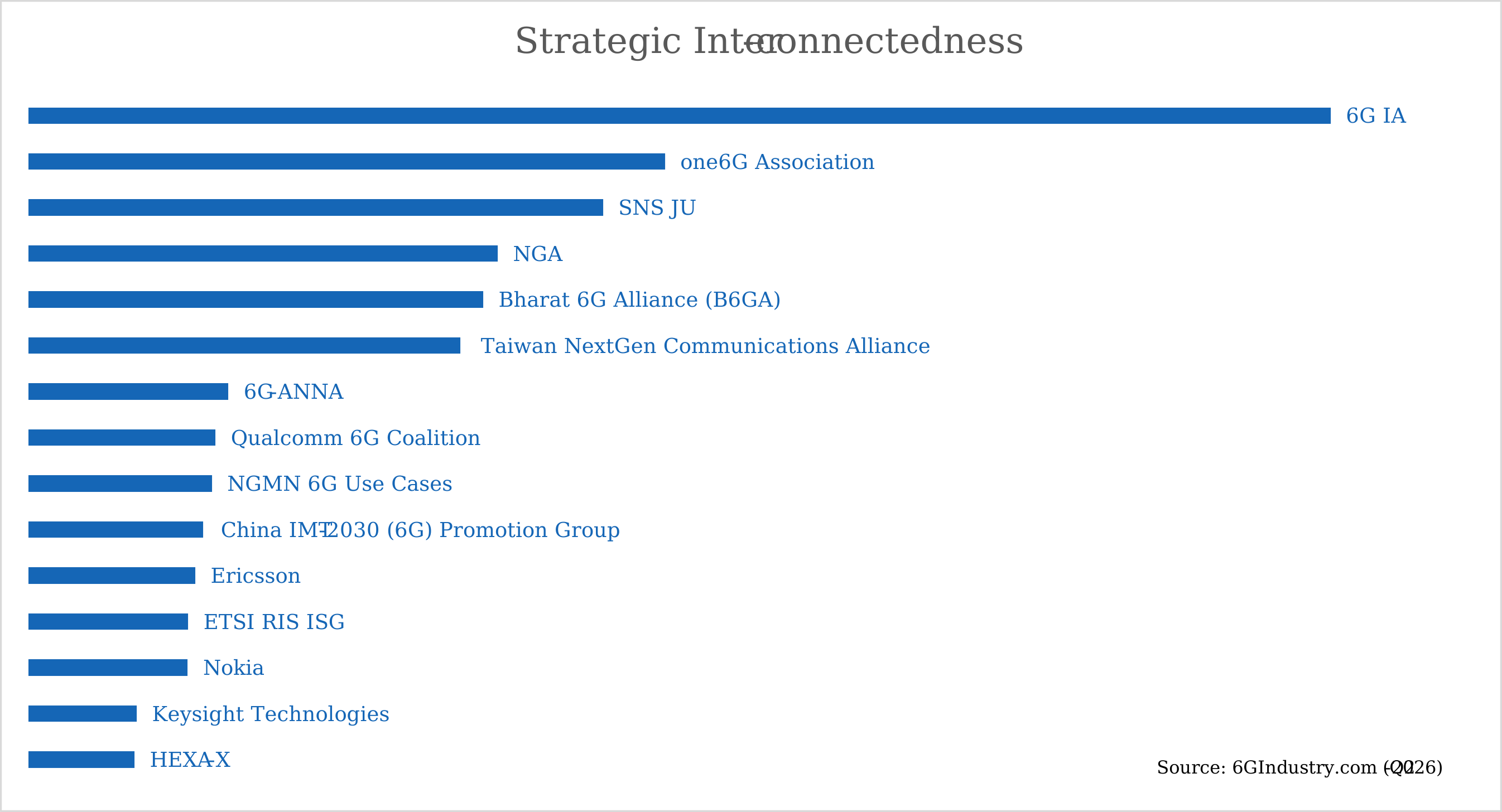
While industry associations and commercial coalitions offer templates to progress the operator-controlled 6G vision, it is important to consider other factors to drive industry change.
Vision, Action, and Outcomes
Positioning network operators as the central actors in the industry landscape sets expectations for network operators. It implies that other industry stakeholders are willing to play along and that that there exists an industry orchestration dynamic.
The first hurdle for network operators requires a significant shift in their operating mind-set, going beyond the focus on cost containment identified in the ”Profitable 6G” industry survey. The cost dominated attitude risks dismissing value-creating ideas and is detrimental to pursuing strategic growth and business-control opportunities. Moreover, the commercial boundaries between network operators, their communications services business units, and cloud-based communications providers are changing. Not only will this affect internal alignment in MNOs, but it will also reshape industry competition and how customers are served.
The operator-controlled goal must also contend with other 6G visions. These include platform and ecosystem-enablement, combinations of communications and computing sectors, and system-of-system visions. And that is without considering longer horizon prospects commensurate with 6G usage dynamics over the next couple of decades.
The challenge of aligning interests among the six other stakeholder groups that Solandi identified will need to navigate several headwinds. Each grouping has a different industry role; there is no guarantee that their strategic goals align in the absence of overarching policy and regulatory mandates.
Soldani highlights end-to-end service delivery as an important determinant of the guaranteed service model. The effects of geopolitical tensions and digital-economy regulation are likely to narrow the reach of the operator-controlled 6G model.
To implement the operator-controlled 6G concept at scale, will involve industry persuasion and a strategy built on a mix of advocacy, education, and deep subsidization (of the kind seen in the solar panel and AI language model industries). The scale of such an undertaking contrasts with the approach that MNOs currently rely on for advocacy. This happens through 3GPP meetings and industry associations (e.g., NGMN white papers, GSMA working groups). It remains to be seen what commitments Rakuten Mobile will make to move the 6G market, and how its market development initiatives will contribute to the industry’s 6G journey.