
There are several reasons why 6G has become a political issue. These include geo-political rivalry, nations seeking to be the ‘first’ to launch 6G, aspirations about a nation’s industry-strategy, and concerns over technology supply chains and digital sovereignty.
There are also cases where governments are chasing economic opportunities linked to 6G. The launch of 6GFlagship with Finnish government involvement is one example targeting national strategy and the formation of a local ecosystem.
A more recent example is India’s aim, as announced by its Prime Minister, to account for 10% of 6G patents. This aspiration will trigger significant changes in India’s communications sector ecosystem. It will draw in research institutions, intellectual property experts, and patent specialists among others.
To explore how governments are active in the 6G industry, here are two views from the 6G industry map. The first contains a map of government agencies in different countries. The second depicts government-launched 6G-initiatives such as 6G events (e.g., strategic workshops), signing Memoranda of Understanding (MoUs), launching collaborative ventures, and investing in resources for project undertakings.
Government Agency Connections
The map below shows the top ten country clusters (out of all countries in the 6G Industry map) and the different government bodies that have either announced or are participating in 6G related activities. The most prominent nations, based on an organizational count, are Finland, Germany, India, South Korea, the United Kingdom, and the United States.
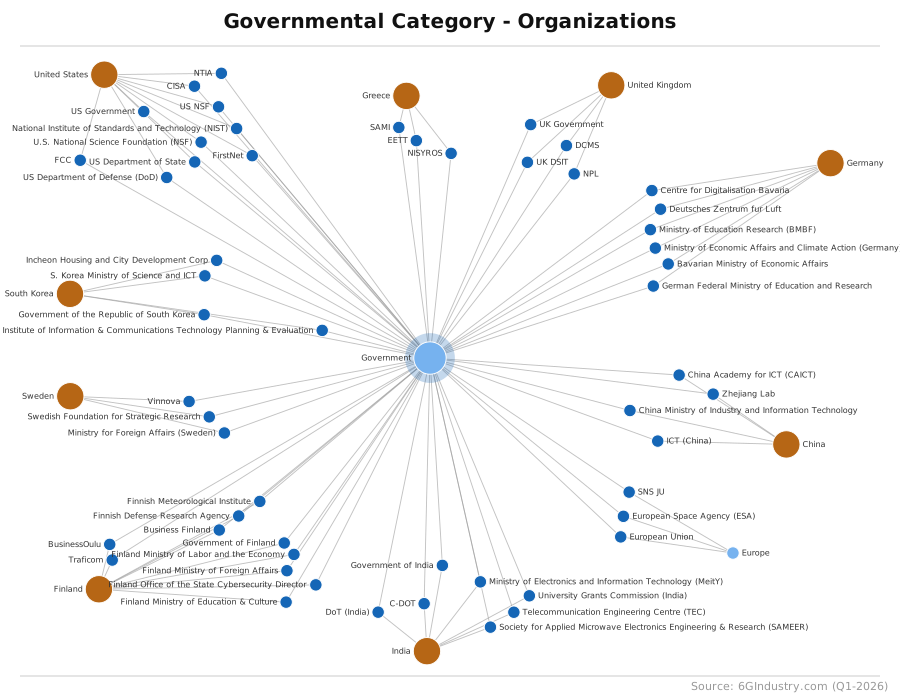
The United States stands out for the number of channels through which government is promoting 6G. In addition to the European nations, Europe (lower right-hand side of illustration) plays a continent-wide role via the European Union (policy and funding), SNS JU (program for 6G), and the European Space Agency (technical contributions).
Government Initiatives to Support 6G
The presence of Government agencies in the industry map is one measure of their commitment to 6G. The next step in exploring the 6G industry map is to study how agencies are translating policy into action and market impact. This can involve the allocation of resources, co-signing Memoranda of Understandings (MoUs), convening strategic events, and investing through joint ventures or projects. Here is how that kind of support shows up in the 6G industry map for the ten most active nations.
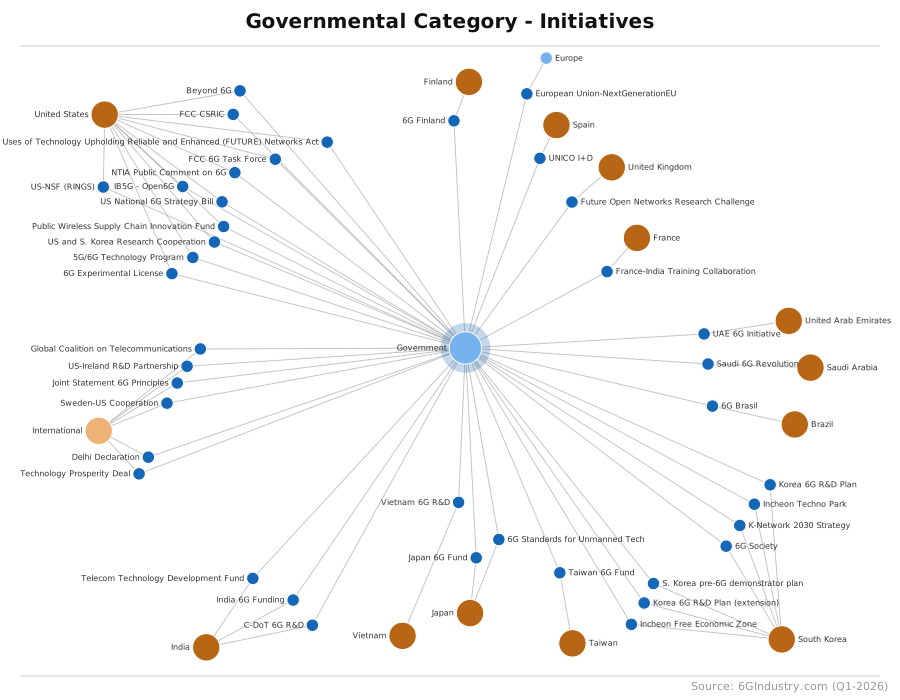
The United States and South Korea are the most active in this industry picture. There is a sizeable cluster for the “International” category where action takes the form of cross-border partnerships and declarations of shared-intent design principles.
The picture also paints a picture of wider ambition towards 6G and a recognition that 6G will be a strategic technology. Examples of government-led policy and resourcing initiatives include Brazil (6G Brazil), Finland (6G Finland), Saidi Arabia (Saudi 6G Revolution), the United Arab Emirates (UAE 6G Initiative), Taiwan (Taiwan 6G Fund), and Vietnam (Vietnam 6G R&D) to name but a few.